
YouTube no-cookie is not enough for Europe

As cookie banners become harder to justify, many organizations look for quick fixes. One of the most common is YouTube’s so-called no-cookie embed.
At first glance, it sounds ideal. Enable privacy-enhanced mode, reduce tracking, remove the consent banner, move on. For organisations under pressure to simplify compliance and improve user experience, it feels like the obvious solution.
But YouTube no-cookie doesn’t remove the problem. It just makes it harder to see.
The comforting myth of “no cookies”
The promise behind YouTube’s no-cookie mode is simple: if no cookies are set, privacy risks disappear and you’ll be GDPR compliant.
That logic is understandable but wrong. Privacy regulation does not care about cookies. It cares about who processes personal data, for what purpose, and on whose infrastructure.
Cookies are only one technical mechanism. Eliminating them does not automatically eliminate identifiers, data flows, or third-party processing.
What YouTube still sees - even in no-cookie mode
Even in privacy-enhanced mode, a YouTube video is delivered entirely through Google’s infrastructure.
That means:
- The viewer’s IP address is processed
- Playback events are visible to Google servers
- Device and browser characteristics are exposed
- Logged-in users can be associated across Google services
None of this requires cookies. None of it is optional. And none of it disappears because a different embed URL is used. This is why YouTube no-cookie embeds should still trigger consent banners on European websites - or stop working entirely when tracking is rejected by default.
Error 153: the referer makes it explicit
YouTube no-cookie embeds recently started requiring something else as well: an explicit referer attribute. If the embedded player does not receive a referrer, playback is blocked with error 153. In practice, this means that Google wants to receive the domain on which the video is embedded, and it’s not a choice.
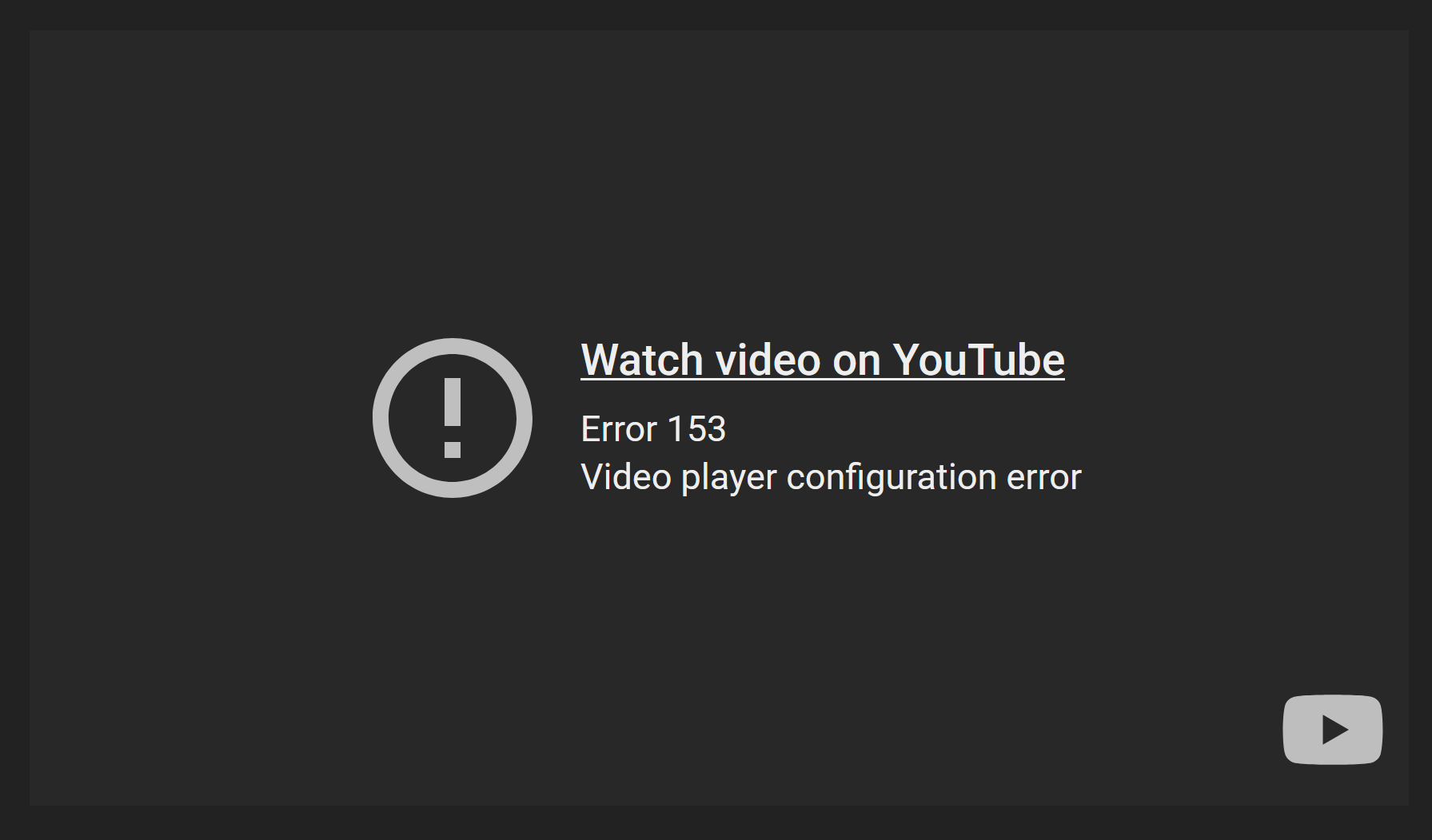
The referrer is not a cookie. It cannot be turned off by the user and it is required for playback to work.
This adds a new layer of contextual data to the existing technical signals: the website you are visiting, combined with IP address, device information (fingerprint), and playback behavior.
All of it happens outside cookie consent. “No-cookie” does not mean “no data”. It means data you cannot opt out of.
No-cookie is not the same as cookie-free
This distinction matters. No-cookie mode reduces initial cookie placement, but personal data is still processed by a third party.
Cookie-free video does not rely on:
- Cookies
- Identifiers
- IP-based/fingerprinting analytics
- Advertising infrastructure
When no personal data is processed, consent requirements typically do not apply. That is the difference between mitigating a privacy problem and eliminating it.
Why no-cookie keeps breaking under enforcement
Solutions like privacy-enhanced embeds, delayed loading, or two-click video players exist because platforms like YouTube were never designed for privacy-first use cases. They are patches layered onto infrastructure whose business model depends on data.
As enforcement shifts from banner-based consent toward default-deny and browser-level signals, those tolerances disappear. When browsers enforce user intent automatically, platforms that depend on implicit data flows increasingly stop working. For a deeper look at how browser-level consent is reshaping video, read our post The end of cookie-based video in Europe.
If the problem is architectural, the solution has to be architectural too. Even the best sometimes don’t get it right, but you have to be consequential.
Why Mave doesn’t need exceptions
Mave was designed specifically for the European privacy context.
No cookies. No tracking. No advertising infrastructure.
Compliance is not a setting. It is the foundation. That is why Mave videos don’t need privacy modes, banners, or fallbacks.
Privacy-first video is the sustainable choice
YouTube’s no-cookie mode is not the end of cookie-based video. As consent moves out of banners and into browsers, partial solutions will no longer be enough.
As European enforcement tightens, organizations face a practical decision:
Rely on video platforms that depend on third-party data flows, and accept increasing friction and uncertainty. Or choose video that works without cookies, without consent walls, and without compromising user trust.
Privacy-first video is no longer a tradeoff. In Europe, it’s the only model that still works by default.